
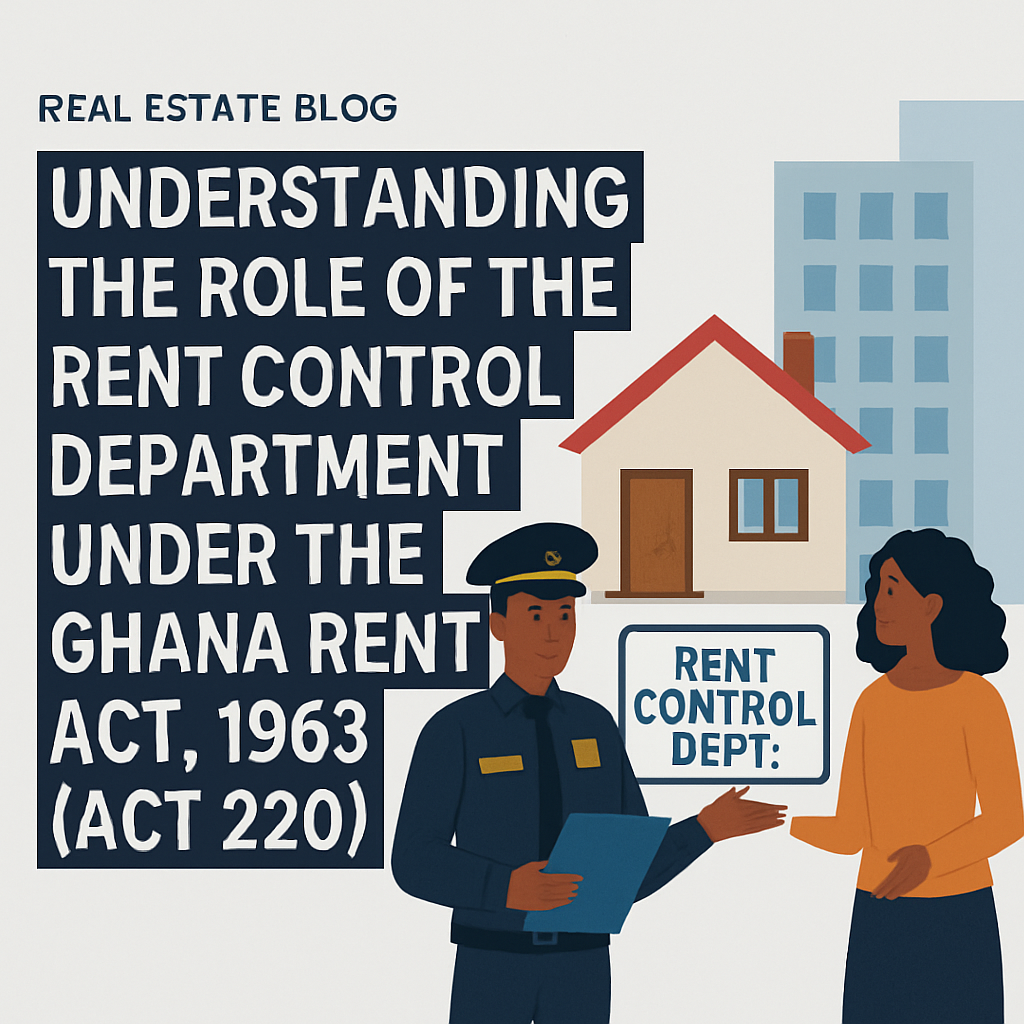
Understanding the Role of the Rent Control Department under the Ghana Rent Act, 1963 (Act 220)
This article explores the legal authority of the Rent Control Department in Ghana regarding rent pricing and assessments as stipulated in the Rent Act, 1963 (Act 220).
The Rent Control Department is the government institution responsible for administering and enforcing the provisions of the Ghana Rent Act, 1963 (Act 220). Its primary role is to promote fairness in landlord–tenant relationships by carrying out the functions assigned to it under the law.
One area that often causes confusion is whether the Rent Control Department has the legal authority to fix or determine the rent that landlords should charge. Understanding the Department's statutory role is important for both landlords and tenants seeking to comply with the law.
The Legal Framework
The Ghana Rent Act establishes the Rent Control Department as the body responsible for administering various aspects of the country's rental housing system.
Among its functions are:
- Administering the provisions of the Rent Act.
- Receiving and handling complaints relating to landlord–tenant matters.
- Assisting in the resolution of tenancy disputes.
- Conducting inspections and assessments where required by law.
- Determining Recoverable Rent in accordance with Section 14 of the Act.
The Act provides a legal framework for these responsibilities rather than granting unlimited discretion over rental prices.
Does the Rent Control Department Fix Rent Prices?
One of the most common misconceptions is that the Rent Control Department can simply announce or prescribe the rent that every landlord should charge.
The Ghana Rent Act does not establish a system of fixed rental prices for all properties. Instead, the law provides for the determination of Recoverable Rent through the legal assessment process set out under Section 14.
This means that where the law requires the determination of Recoverable Rent, it should be based on an assessment of the property and the relevant factors provided for under the Act, rather than on assumptions, public opinion, or arbitrary decisions.
Property Assessments and Inspections
A key responsibility of the Rent Control Department is conducting inspections and assessments where necessary.
These assessments are important because they allow the Department to examine factors relevant to determining Recoverable Rent, including:
- The location of the property.
- The size and accommodation provided.
- The age and condition of the building.
- The quality of construction.
- Available facilities and services.
- Improvements made to the property.
- Other relevant factors recognized under the law.
The purpose of the inspection is to ensure that any determination is based on objective facts rather than speculation.
Why Assessments Are Important
The assessment process serves several important purposes:
- It ensures that each property is evaluated individually.
- It promotes fairness for both landlords and tenants.
- It provides an objective basis for determining Recoverable Rent.
- It helps prevent decisions based solely on opinion or market perception.
- It supports transparency and consistency in the administration of the Rent Act.
Without a proper assessment, it may be difficult to establish whether the rent charged for a particular property is consistent with the legal framework.
Practical Example
Suppose a tenant believes that the rent being charged for an apartment is excessive.
Rather than relying solely on comparisons with neighbouring properties or personal opinions, the matter may be referred to the Rent Control Department for consideration under the procedures established by the Rent Act.
Where appropriate, the Department may inspect the property and carry out the necessary assessment before determining the Recoverable Rent in accordance with the law.
Likewise, a landlord who believes the rent for a property should be reviewed may also seek the appropriate legal process provided under the Act.
Why Understanding the Department's Role Matters
Understanding the role of the Rent Control Department helps both landlords and tenants to:
- Know the proper legal procedures for resolving rent disputes.
- Appreciate the importance of property inspections and assessments.
- Avoid misunderstandings about the Department's statutory powers.
- Promote compliance with the Ghana Rent Act.
- Encourage fair and lawful tenancy relationships.
Conclusion
The Rent Control Department plays an important role in administering the Ghana Rent Act, 1963 (Act 220) and promoting fairness in Ghana's rental sector. Its responsibilities include handling landlord–tenant matters and, where required by law, determining Recoverable Rent through inspections and assessments carried out in accordance with Section 14 of the Act.
Understanding these functions helps landlords and tenants appreciate the legal processes established by the Rent Act and encourages rental disputes to be resolved through lawful, transparent, and evidence-based procedures rather than assumptions or arbitrary decisions.
 How to Find a House for Rent in Ghana Without Wasting TimeSep 29, 2026
 Understanding the Ghana Rent Act, 1963 (Act 220) on Advance RentJul 25, 2026
 Common Disputes Between Landlords and Tenants in Ghana: A Legal PerspectiveJul 25, 2026