
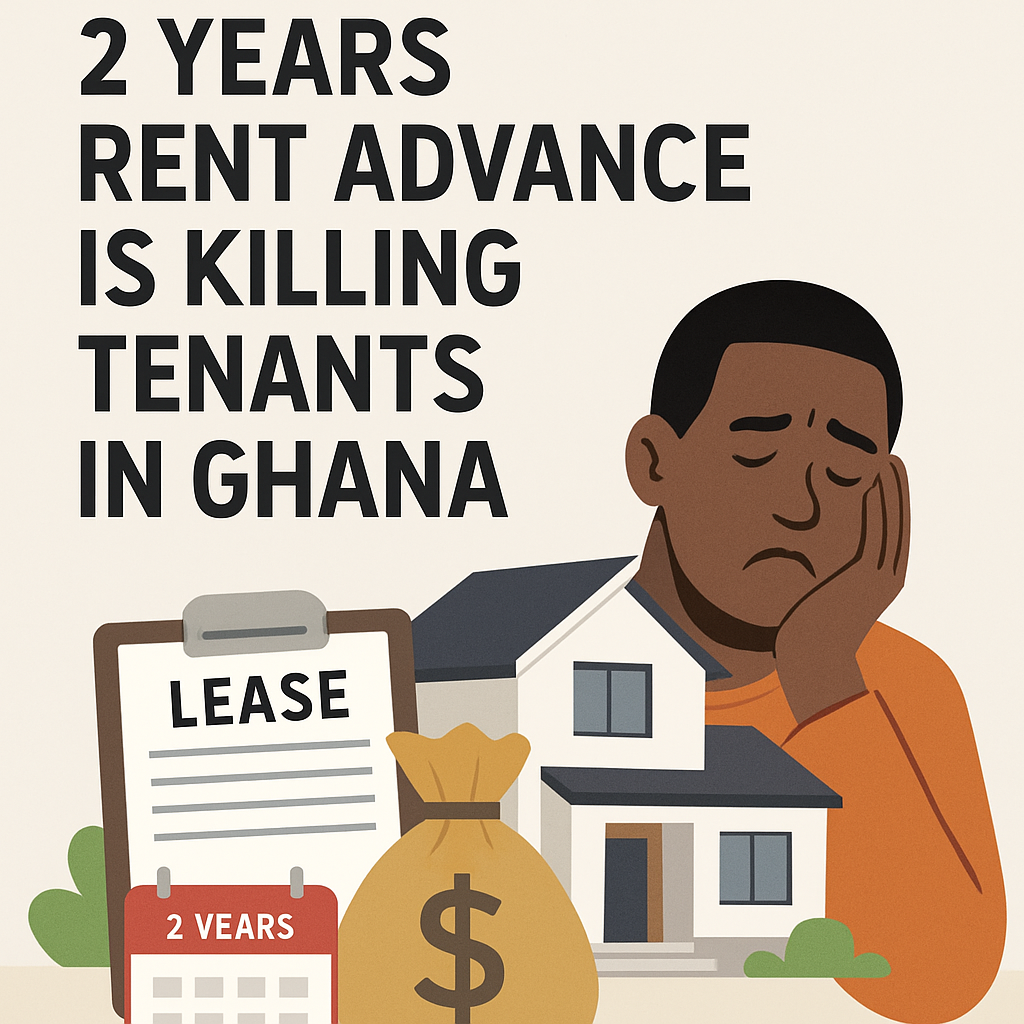
Why Paying 2 Years Rent Advance Is Killing Tenants in Ghana
The practice of demanding two years' rent in advance in Ghana is placing immense financial pressure on tenants. Explore the implications and potential solutions to this housing crisis.
Is rent advance protecting the housing market—or destroying it? Across Ghana, the demand for tenants to pay one to two years’ rent upfront has become the norm rather than the exception. While many landlords see this as a necessary safeguard, the reality on the ground tells a different story. For tenants, this practice is creating intense financial pressure and contributing to a growing housing crisis.
This article takes a closer look at how two-year rent advance is affecting tenants, why landlords insist on it, and what can be done to create a fairer system.
The Heavy Financial Burden on Tenants
For the average Ghanaian worker, paying two years’ rent in advance is not just difficult—it is often impossible.
In many cities, rent prices are high compared to income levels. When tenants are asked to pay 12 to 24 months upfront, the total amount can exceed what they earn in an entire year. This forces many people into extreme financial decisions just to secure a place to live.
Instead of planning for the future, tenants are pushed into survival mode. Some drain their life savings, while others turn to loans with high interest rates. The result is long-term financial instability.
This situation has serious consequences:
- People struggle to afford basic needs like food, healthcare, and transportation
- Emergency savings become non-existent
- Young professionals delay independence and continue living in overcrowded homes
- Families are forced into substandard or distant housing options
What should be a basic necessity—housing—becomes a major financial burden.
Why Landlords Insist on Advance Payments
To understand the full picture, it is important to consider the landlords’ perspective.
Many landlords argue that collecting rent in advance protects them from losses. In a system where enforcing rent agreements can be slow and frustrating, upfront payment provides a sense of security. If a tenant defaults, the landlord has already secured income for a period of time.
There are also broader market issues at play:
- Weak enforcement of tenancy laws
- Delays in eviction processes
- Rising construction and maintenance costs
- Economic uncertainty and inflation
Because of these challenges, landlords often prioritize immediate financial returns over long-term rental stability. Over time, this has created a culture where large advance payments are seen as standard practice rather than an exception.
The Bigger Problem: A Broken Rental System
The issue goes beyond tenants versus landlords. The truth is, the system itself is under strain.
When tenants cannot afford rent, occupancy rates drop. When landlords struggle to recover costs, they increase rent demands. This cycle continues, making housing less accessible for everyone.
The gap between income levels and rental costs continues to widen, especially in urban areas. Without proper regulation and balance, both tenants and landlords end up losing in the long run.
Possible Solutions to the Rent Advance Crisis
Solving this problem requires practical and balanced approaches that protect both tenants and landlords.
1. Enforce Existing Rent Laws
Ghana’s rent laws already place limits on excessive advance payments. Stronger enforcement can help regulate the system and reduce abuse.
2. Introduce Flexible Payment Systems
Monthly or quarterly payment structures should be encouraged. This makes housing more accessible while still ensuring landlords receive consistent income.
3. Strengthen Legal Protection for Landlords
A faster and more efficient dispute resolution system can give landlords confidence to reduce advance payment requirements.
4. Promote Rental Financing Options
Financial institutions can introduce rent support schemes that allow tenants to spread payments over time without resorting to high-interest loans.
5. Increase Affordable Housing Supply
Government and private sector partnerships can help reduce pressure on the rental market by providing more housing options.
Conclusion
The demand for two years’ rent advance may seem like a solution for landlords, but in reality, it is placing a heavy burden on tenants and weakening the housing system as a whole.
If left unchecked, this practice will continue to push many Ghanaians out of decent housing and deepen financial inequality.
A balanced approach—one that protects investments while ensuring affordability—is not just necessary, it is urgent. By reforming policies, improving enforcement, and embracing fair rental practices, Ghana can move towards a housing system that works for everyone.
 How to Find a House for Rent in Ghana Without Wasting TimeSep 29, 2026
 Understanding the Ghana Rent Act, 1963 (Act 220) on Advance RentJul 25, 2026
 Common Disputes Between Landlords and Tenants in Ghana: A Legal PerspectiveJul 25, 2026