
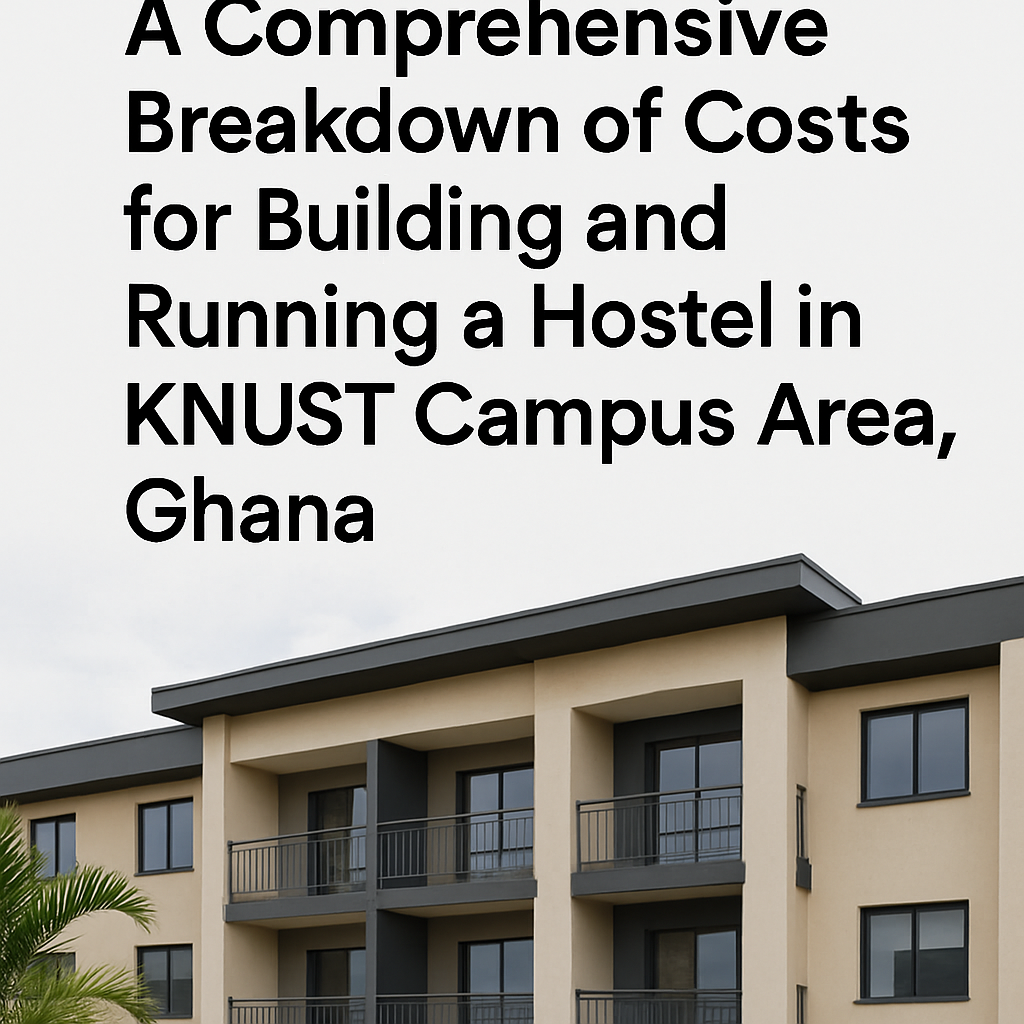
A Comprehensive Breakdown of Costs for Building and Running a Hostel in KNUST Campus Area, Ghana
Discover the detailed financial aspects of establishing and operating a hostel in the KNUST Campus Area, including costs, financing options, and operational expenses.
Why Building a Private Student Hostel Around KNUST Is a Long-Term Investment
Introduction
Student accommodation around KNUST has become one of the most active areas of real estate investment in Kumasi. Areas such as Ayeduase, Bomso, Kotei, Boadi, Twumduase, and Kentinkrono continue to attract private hostel developers because of the high demand from students.
However, many people judge hostel rent only by the amount students pay every academic year. They often forget the true cost of land, construction, financing, maintenance, staffing, utilities, taxes, and long-term capital recovery.
This article explains why building and operating a private student hostel around KNUST is a capital-intensive investment and why, in many cases, it can take 20 to 40 years or more for a hostel owner to fully recover the investment.
The Hostel Model Used for This Assessment
For this assessment, the model used is a 50-room private hostel with 4-in-1 rooms. This means each room accommodates four students, giving the hostel a total capacity of 200 students.
The building is assumed to be a 4-storey hostel block on two plots of land, each measuring about 90 feet by 80 feet. The hostel includes facilities such as a reception, manager’s office, security post, caretaker room, laundry area, study/common area, borehole and water tanks, CCTV, fire safety systems, fence wall, paved compound, backup power, and internet setup.
A 200-bed hostel is used because smaller hostels, especially 100-bed facilities, may struggle to recover investment when land cost, staff cost, maintenance, taxes, and finance costs are properly considered.
Market Conditions Around KNUST
KNUST official hostel fees provide a useful benchmark for student accommodation pricing. For the 2025/2026 academic year, official GUSSS hostel fees for Ghanaian applicants show fees around GH¢6,194 for 4-in-1 rooms, GH¢7,327 for 3-in-1 rooms, and GH¢9,581 for 2-in-1 rooms.
However, private hostels around KNUST may charge higher or lower fees depending on location, distance from campus, facilities, room quality, and demand. Private hostel listing platforms show wide price differences, with some hostels starting around GH¢3,030, GH¢3,800, GH¢4,200, GH¢8,500, and even GH¢10,000.
This shows that the student hostel market is active, competitive, and highly influenced by location and facility standards.
Land Cost: One of the Biggest Barriers
Land near KNUST is one of the biggest cost drivers for hostel development. Current hostel and commercial land listings around Ayeduase, Kotei, and Twumduase show prices ranging from about GH¢600,000 to more than GH¢2.2 million per plot.
For this assessment, the land cost used is GH¢1.5 million per plot. Since the project requires two plots, the estimated land purchase cost alone is GH¢3 million.
Additional land-related costs include agency commission, legal verification, Lands Commission searches, stool or family land checks, survey work, site plan preparation, documentation, registration, and stamp/legal processing.
The estimated total land acquisition cost is about GH¢3.4 million.
This means before the developer even starts construction, millions of Ghana cedis may already be spent on land and documentation.
Pre-Construction and Approval Costs
A serious hostel project requires professional planning before construction begins. This includes feasibility studies, architectural drawings, structural engineering drawings, electrical and plumbing drawings, fire safety planning, quantity surveying, soil testing, legal documentation, and building permits.
For this 200-bed hostel project, the estimated pre-construction and approval cost is about GH¢850,000.
These costs are necessary because a hostel is not just a normal residential building. It houses many people, uses more utilities, requires stronger safety planning, and must meet building and local authority requirements.
Construction Cost of the Hostel
The estimated gross floor area used for this hostel is about 2,200 square metres. Using a construction rate of about GH¢5,300 per square metre, the base building cost is estimated at GH¢11.66 million.
This includes foundation works, reinforced concrete frame, columns, slabs, staircases, blockwork, plastering, roofing, plumbing, sanitary fittings, electrical wiring, fire systems, tiling, ceilings, painting, and general finishing.
Hostel construction is expensive because the building has many bathrooms, plumbing lines, electrical points, corridors, staircases, furniture needs, and high usage pressure compared to a normal house.
The estimated core construction cost is GH¢11.66 million.
External Works and Services
Beyond the main building, a hostel also requires external works and services. These include fence walls, gates, security post, paved compound, drains, borehole, water tanks, ECG connection upgrades, generator or backup power, CCTV, internet infrastructure, signage, compound lighting, and landscaping.
The estimated cost for external works and building services is about GH¢2.4 million.
These are not luxury items. They are necessary for security, comfort, safety, and proper operation of a student hostel.
Furniture, Fittings, and Equipment
A 200-bed hostel must also be furnished before students can move in. The estimated furniture and equipment include beds, mattresses, wardrobes, lockers, study tables, chairs, curtains, office furniture, cleaning equipment, laundry equipment, fire extinguishers, and room notices.
The estimated cost for furniture, fittings, and equipment is about GH¢1.4 million.
This is another major cost that many people ignore when discussing hostel rent.
Contingency and Total Project Cost
In Ghana, construction costs can change quickly due to material price increases, transport costs, labour delays, exchange rate changes, and design adjustments. For this reason, a contingency of about 12% is included.
The estimated contingency is GH¢1.855 million.
The total estimated project cost before finance cost is therefore about GH¢21.565 million.
When finance cost is added, the final estimated project cost rises to about GH¢24.265 million.
This gives an estimated cost per student bed of about GH¢121,325.
Finance Cost During Construction
If the developer uses a bank loan or overdraft, the cost of the project increases significantly.
For example, if the owner borrows GH¢10 million at an assumed 18% annual interest rate during construction, the finance cost during a 2.5-year construction period can be about GH¢2.25 million. If an overdraft or short-term working capital facility is also used, the total finance cost can rise further.
In this assessment, the estimated finance cost during construction is about GH¢2.7 million.
This shows why bank-financed hostel projects are very difficult. Interest alone can add millions of cedis to the total investment cost before the hostel even starts operating.
How Long Does It Take to Build?
A properly financed hostel project around KNUST may take between 2.5 and 4 years to complete.
The timeline may include 3 to 6 months for land search and due diligence, 4 to 8 months for design and approvals, 3 to 9 months for financing arrangements, 18 to 30 months for construction, and 2 to 3 months for furnishing, testing, fire safety, and handover.
If the owner is building mainly from personal savings, the project can take 5 to 8 years or more because construction may stop and start depending on available funds.
Annual Running Cost of the Hostel
After construction, the owner must still spend money every year to keep the hostel running.
Staffing costs may include a hostel manager, assistant managers or caretakers, cleaners, security guards, accountant or administrator, relief staff, welfare, uniforms, and employer SSNIT contributions.
The estimated annual staffing cost is about GH¢354,600.
Other operating costs include electricity, water, borehole maintenance, internet, CCTV maintenance, generator fuel, waste collection, cleaning materials, pest control, repairs, insurance, property rate, legal fees, accounting, software, marketing, and operational contingency.
The estimated annual non-tax operating cost is about GH¢940,000.
This means before the owner thinks about profit, almost GH¢1 million may be needed every year to run and maintain the hostel.
Taxes and Statutory Costs
Hostel owners must also consider tax and statutory obligations. These may include rent income tax, corporate income tax where applicable, PAYE for employees, SSNIT contributions, property rates, local permits, and possible VAT issues depending on how the accommodation business is structured.
For residential rent, Ghana Revenue Authority rates commonly refer to 8% rent tax for residential premises and 15% for commercial or non-residential premises.
Student hostel rent is generally treated as residential rent unless the business is structured differently. However, hostel owners should always seek advice from a qualified tax advisor because tax treatment can depend on the structure of the business.
Revenue Projection
Assuming 200 beds and 95% occupancy, about 190 students will be paying rent.
If each student pays GH¢6,500 per academic year, total rent revenue will be about GH¢1.235 million. After 8% rent tax and operating cost, the estimated net operating income before debt may be only about GH¢196,200.
If each student pays GH¢8,500, the estimated net operating income before debt may be about GH¢545,800.
If each student pays GH¢10,000, the estimated net operating income before debt may be about GH¢808,000.
If each student pays GH¢12,000, the estimated net operating income before debt may be about GH¢1.157 million.
These figures show that even when hostel fees look high, the actual net income after operating expenses and tax may be much lower than many people think.
Payback Period
Using the estimated total project cost of GH¢24.265 million, the payback period becomes very long.
- At GH¢6,500 per student, the estimated payback period may be around 124 years.
- At GH¢8,500 per student, the estimated payback period may be around 44 years.
- At GH¢10,000 per student, the estimated payback period may be around 30 years.
- At GH¢12,000 per student, the estimated payback period may be around 21 years.
This is before considering major renovations, loan repayment pressure, inflation, vacancy, unpaid utility bills, court cases, bad tenants, and emergency repairs.
The Effect of Bank Loans
If the owner borrows GH¢10 million at 18% interest for 10 years, annual loan repayment may be around GH¢2.2 million to GH¢2.4 million.
This creates a serious challenge.
Even if the hostel charges GH¢10,000 per student and generates about GH¢808,000 net operating income before debt, that amount may still not be enough to service the loan comfortably.
This explains why many hostel developers prefer personal savings, phased construction, diaspora funding, family support, landowner joint ventures, or long-term patient capital.
Why Hostel Rent Cannot Be Judged by Emotions Alone
Many people see hostel rent and quickly conclude that hostel owners are making too much profit. But proper assessment shows a different picture.
A hostel owner must recover land cost, construction cost, furniture cost, finance cost, staff cost, maintenance cost, utility cost, tax obligations, insurance, security, and risk exposure.
Therefore, hostel rent should not be judged only by saying, “It is too expensive.” A fair assessment must consider the full cost of providing the accommodation and the realistic period required to recover the investment.
Key Findings
A new private hostel around KNUST is very capital intensive. The biggest cost drivers are land, concrete structure, plumbing, electrical works, furniture, finance cost, utilities, and maintenance.
The project may take 2.5 to 4 years if properly financed, but 5 to 8 years if built slowly from personal savings.
The realistic capital recovery period is often 20 to 40 years or more, unless the developer already owns the land, builds at very high density, charges premium rent, uses mostly equity, or acquired the land many years ago at a lower cost.
Bank loans and overdrafts make hostel development even more difficult because annual debt repayment can be higher than the hostel’s net operating income.
Conclusion
Building a private student hostel around KNUST is not a short-term profit business. It is a long-term real estate investment that requires huge capital, patience, proper planning, professional advice, and strong financial discipline.
While students and parents are right to demand fair rent, landlords and hostel owners are also right to ask that rent discussions be based on proper assessment and evidence.
The real question should not only be whether hostel rent is high. The better question is whether the rent is fair when land cost, construction cost, finance cost, taxes, maintenance, utilities, staffing, and capital recovery are properly considered.
 The Rising Cost of Rent in Accra (2026): Trends, Drivers, Impacts, and Policy ResponsesMar 4, 2026
 Common Mistakes First-Time Home Buyers Make in GhanaMar 4, 2026
 🏘 Top 10 Affordable Areas to Rent in Accra (2026 Guide)Feb 26, 2026